

Ahsan Fayyaz; Dr. Abdur Rauf Khalid
Faculty of Veterinary Sciences, Bahauddin Zakariya University-Multan
The livestock industry is facing one of the greatest challenges in its history: producing enough food for a growing global population while reducing its environmental impact. As demand for milk, meat, and other animal products continues to rise, scientists and farmers are searching for innovative solutions that can improve animal productivity without compromising environmental sustainability.
One promising answer may lie in an unlikely source—essential oils. Commonly known for their use in perfumes, medicines, and food flavorings, these natural plant extracts are now attracting attention as powerful feed additives capable of transforming rumen fermentation, improving feed efficiency, and reducing greenhouse gas emissions from livestock.
The remarkable world inside a ruminant
Unlike monogastric animals, ruminants such as cattle, buffaloes, sheep, and goats possess a highly specialized digestive system. At the heart of this system lies the rumen, a large fermentation chamber inhabited by billions of microorganisms, including bacteria, protozoa, fungi, and archaea.
These microorganisms perform a remarkable task: they break down complex plant fibers that animals cannot digest on their own and convert them into energy and nutrients. This unique microbial ecosystem enables ruminants to transform low-quality forage into high-quality products such as milk and meat.
However, this natural process comes with a cost. During fermentation, microbes produce methane—a greenhouse gas significantly more potent than carbon dioxide in trapping heat within the atmosphere. Methane emissions from livestock are recognized as a major contributor to global climate change. Furthermore, methane production represents a direct loss of dietary energy that could otherwise be utilized for growth, milk production, and reproduction.
In addition to methane, excessive degradation of dietary protein in the rumen leads to ammonia production, resulting in nitrogen losses and environmental pollution.
The search for safer feed additives
For decades, livestock nutritionists have used antibiotics, ionophores, and other synthetic compounds to manipulate rumen fermentation and improve animal performance. While these additives often deliver positive results, concerns regarding antibiotic resistance, chemical residues in food products, and consumer health have prompted researchers to seek safer alternatives.
Consumers increasingly prefer food products derived from natural production systems. Consequently, the livestock sector is under growing pressure to reduce reliance on synthetic additives while maintaining productivity and profitability. This challenge has fueled interest in plant-based feed additives, particularly essential oils.
What are essential oils?
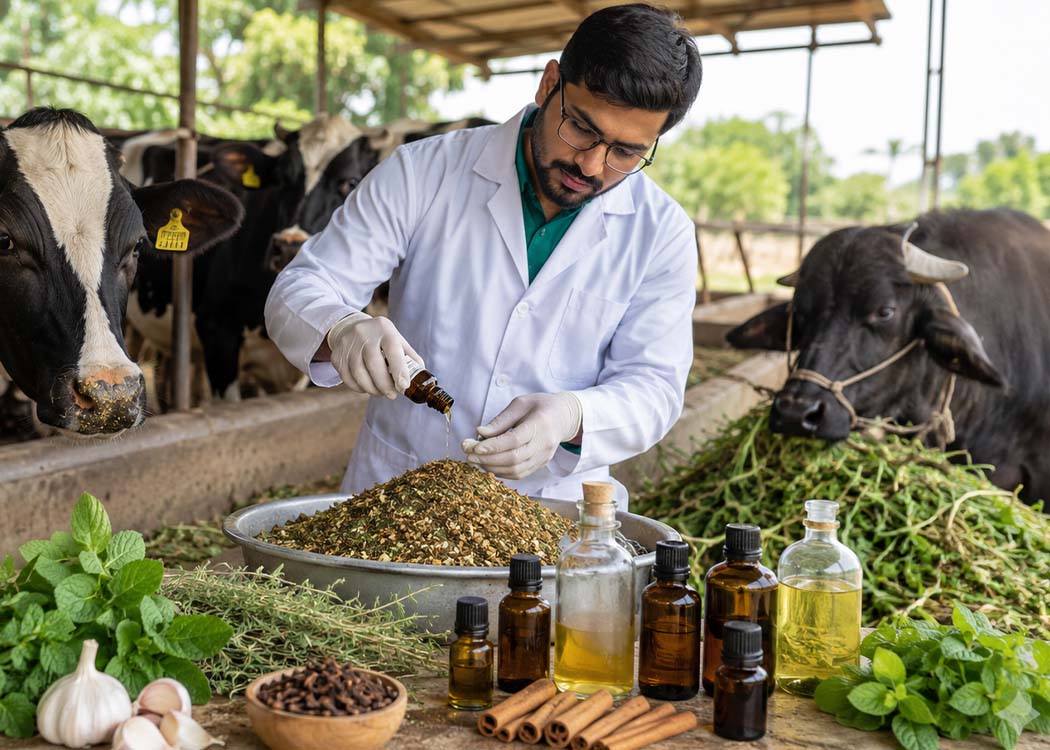
Essential oils are naturally occurring aromatic compounds extracted from various plant parts, including leaves, flowers, bark, roots, stems, fruits, and seeds. They contain a wide range of bioactive substances such as terpenes, phenols, aldehydes, ketones, and alcohols that possess powerful biological activities.
Plants naturally produce these compounds as part of their defense mechanisms against pathogens, insects, and environmental stress. Researchers have discovered that many of these same antimicrobial properties can also be beneficial within the rumen.
Today, more than 3,000 essential oils have been identified worldwide, although only a fraction are used commercially. Oils derived from oregano, thyme, cinnamon, garlic, peppermint, eucalyptus, and clove have shown particularly promising results in animal nutrition.
How essential oils influence rumen fermentation
The effectiveness of essential oils stems largely from their ability to selectively influence microbial populations within the rumen. Rather than eliminating all microorganisms, essential oils can suppress undesirable microbes while allowing beneficial microbial communities to flourish. This selective antimicrobial activity helps optimize fermentation processes and improve nutrient utilization.
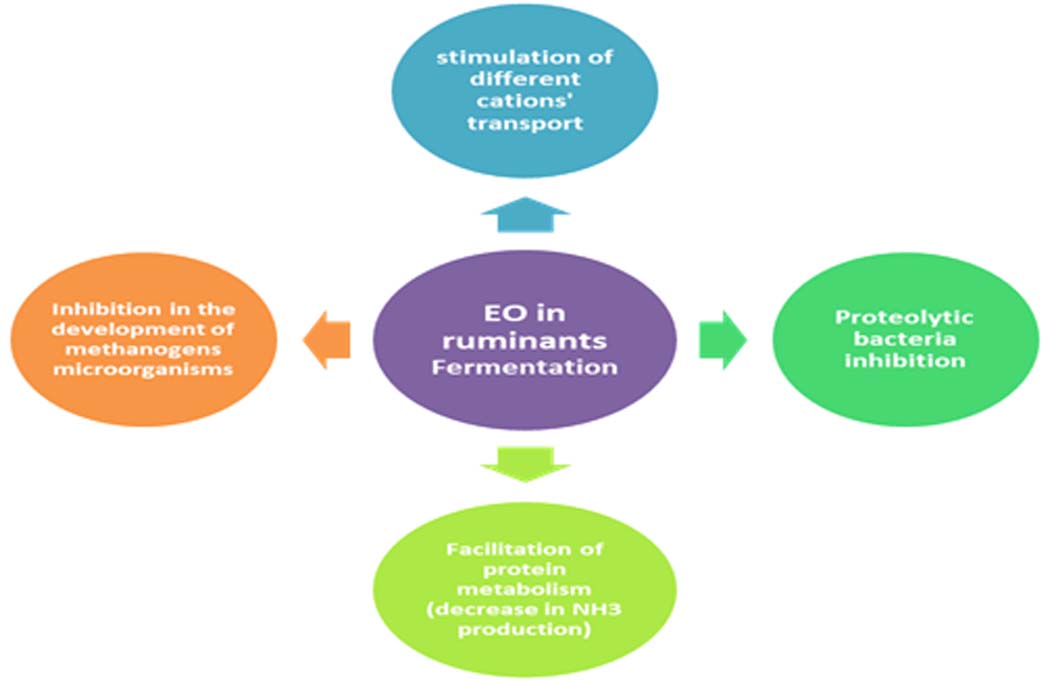
Researchers have identified several mechanisms through which essential oils affect rumen function:
- Inhibition of methane-producing microorganisms
- Reduction of excessive protein degradation
- Improvement of nitrogen utilization
- Modification of volatile fatty acid production
- Enhancement of feed efficiency
- Support of animal health and productivity
These effects collectively contribute to a more efficient and environmentally sustainable production system.
Reducing methane emissions: A climate-smart strategy
Methane reduction has become one of the most important goals in modern livestock production. Livestock agriculture contributes substantially to global methane emissions, with enteric fermentation representing one of the largest sources. Scientists have therefore focused considerable attention on identifying nutritional strategies capable of reducing methane formation.
Essential oils appear particularly promising because of their ability to inhibit methanogenic archaea—the microorganisms primarily responsible for methane production in the rumen.
Studies involving oregano, garlic, cinnamon, clove, eucalyptus, and peppermint oils have demonstrated varying degrees of methane reduction. Some experiments have reported substantial decreases in methane production without negatively affecting animal performance.
Although responses vary depending on oil type, dosage, diet composition, and animal species, the overall findings suggest that essential oils may become valuable tools in climate-smart livestock production systems.
Improving protein utilization
Protein is one of the most expensive components of animal diets. Therefore, maximizing its utilization is economically important for farmers.
Within the rumen, a portion of dietary protein is degraded into ammonia. While some ammonia is utilized by rumen microorganisms, excessive amounts are wasted and ultimately excreted into the environment.
Essential oils have demonstrated the ability to suppress hyper-ammonia-producing bacteria, reducing unnecessary protein breakdown and improving nitrogen efficiency. This means that more dietary protein can be directed toward productive purposes such as growth, milk production, and reproduction rather than being lost as waste.
Effects on volatile fatty acids
Volatile fatty acids (VFAs) are the primary source of energy for ruminants. Their production is a direct result of microbial fermentation within the rumen.
Research indicates that essential oils can influence the proportions of acetate, propionate, and butyrate—the three major VFAs responsible for supplying energy to the animal. Particularly important is the potential increase in propionate production, which is often associated with improved energy efficiency and reduced methane generation. This shift in fermentation patterns may help animals utilize feed more effectively while simultaneously lowering greenhouse gas emissions.
Challenges and future research
Despite the encouraging results reported by numerous studies, several challenges remain.
The effectiveness of essential oils varies considerably depending on their chemical composition, extraction method, dosage level, and interactions with different diets. Results observed under laboratory conditions are not always replicated in commercial farming environments.
Furthermore, long-term studies are still needed to evaluate their impact on animal performance, product quality, economic feasibility, and large-scale implementation.
Researchers must also identify optimal combinations and inclusion rates to maximize benefits while minimizing costs.
A promising future for natural feed additives
As global agriculture seeks sustainable solutions to meet future food demands, essential oils are emerging as one of the most promising natural alternatives to conventional feed additives.
Their ability to improve rumen fermentation, reduce methane emissions, enhance nutrient utilization, and support animal health aligns closely with modern goals of environmental stewardship and sustainable livestock production.
While further research is required before widespread adoption, current evidence suggests that essential oils may play a significant role in shaping the future of animal nutrition. By harnessing the power of nature, the livestock industry has an opportunity to improve productivity, reduce environmental impact, and move toward a more sustainable future for both farmers and consumers.