

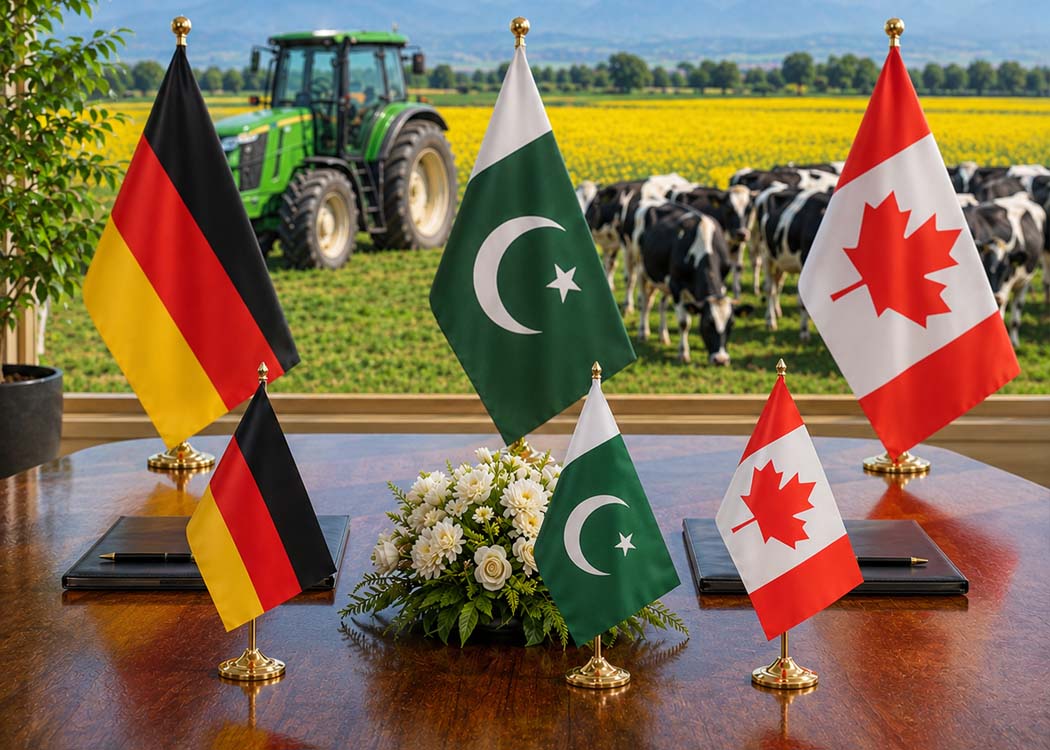
Federal Minister Rana Tanveer Hussain discusses modernization, livestock development, and food security partnerships with German Ambassador and Canadian High Commissioner, focusing on technology transfer, investment, and agricultural productivity
ISLAMABAD: Pakistan has reinforced its push for agricultural modernization and food security cooperation through separate high-level meetings with Germany and Canada, focusing on technology transfer, livestock development, and enhanced agri-trade partnerships.
Federal Minister for National Food Security & Research Rana Tanveer Hussain held discussions with German Ambassador Ms. Ina Lepel and Canadian High Commissioner Mr. Tarik Ali Khan, outlining Pakistan’s priorities for improving agricultural productivity and strengthening international collaboration in the sector.
During his meeting with the German envoy, the Minister emphasized Pakistan’s interest in expanding cooperation in agricultural research, mechanization, livestock genetics, and climate-resilient farming systems. He highlighted that agriculture contributes around 25 percent to Pakistan’s GDP, while low crop yields remain a key challenge.
He proposed collaboration in livestock development, including breed improvement, reproductive technologies, animal feed innovation, and Foot and Mouth Disease (FMD) vaccine production. The Minister also invited German institutions and companies to explore opportunities in dairy modernization, food processing, agricultural mechanization, and slaughterhouse development.
Rana Tanveer Hussain further noted that Pakistan is preparing its first Biotechnology Policy, aimed at encouraging research, innovation, and foreign investment in agriculture. He also stressed the importance of food safety standards, traceability systems, and SPS compliance to improve access to global markets.
German Ambassador Ms. Ina Lepel welcomed Pakistan’s efforts and reaffirmed Germany’s commitment to strengthening cooperation in agriculture, climate resilience, livestock development, and research. She also expressed interest from German companies in exploring investment opportunities in Pakistan.
In a separate meeting with Canadian High Commissioner Mr. Tarik Ali Khan, discussions focused on agricultural trade, agri-business investment, and technology transfer. The Minister highlighted Canada’s global leadership in mechanized farming, seed technology, and sustainable agriculture, noting strong potential for bilateral collaboration.
Pakistan’s reliance on edible oil imports—estimated at $4 to $5 billion annually—was highlighted as a key area for cooperation, with particular emphasis on expanding canola cultivation through Canadian expertise in seed development, precision agriculture, and mechanized farming systems.
The Minister also underscored Pakistan’s export potential in agricultural commodities including rice, mangoes, kinnow, dates, and halal meat, stating that stronger cooperation could enhance market access, value addition, and investment opportunities for both countries.
Canadian High Commissioner Mr. Tarik Ali Khan reaffirmed Canada’s commitment to deepening agricultural cooperation with Pakistan and noted ongoing engagement with Canadian provinces and stakeholders to explore investment opportunities in Pakistan’s agriculture and livestock sectors.
Both sides acknowledged the importance of strengthening collaboration in agricultural research, food processing, livestock development, capacity building, and agri-technology to support long-term food security and economic growth. The meetings concluded with a shared commitment to advancing sustainable agricultural development and building stronger bilateral partnerships aimed at modernizing Pakistan’s agriculture sector.