

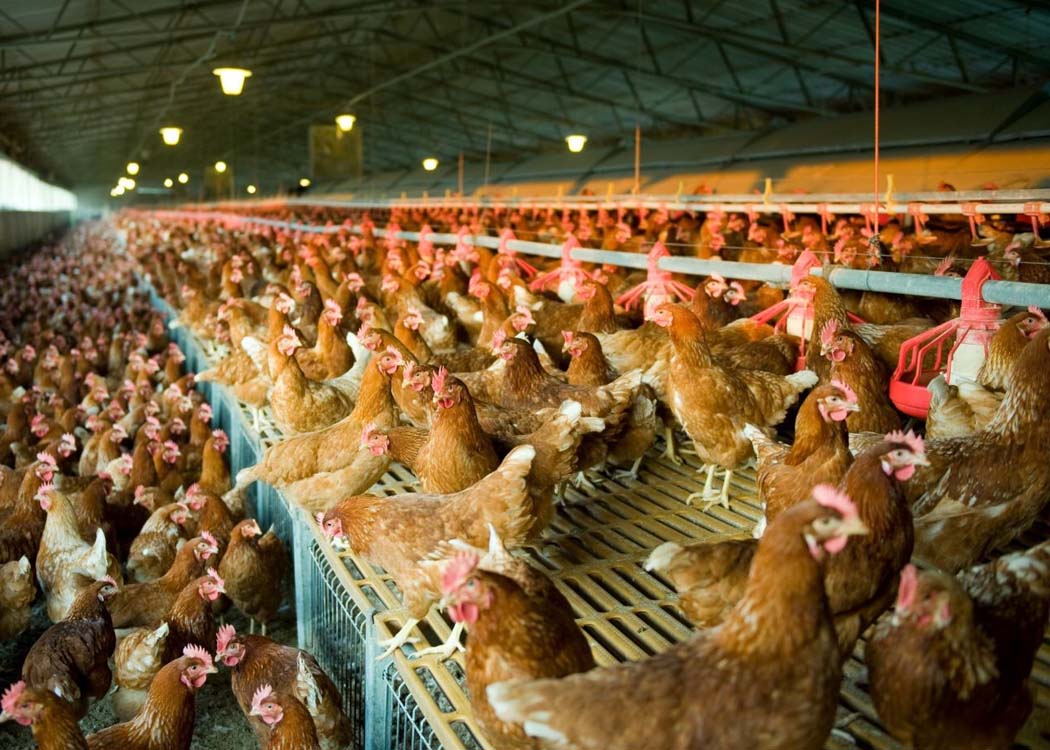
The European Commission’s new operating rules will extend coverage to more poultry farms, including smaller egg, turkey and duck operations, with compliance deadlines staggered from 2030 to 2032.
BRUSSELS: Nearly twice as many poultry farms in the European Union are expected to fall within the scope of revised emissions rules, as the European Commission introduces new limits and operating requirements aimed at reducing pollution from large poultry and pig farms.
Adopted on October 8, 2026, the new rules establish common requirements for ammonia emissions from poultry housing and nitrogen and phosphorus excretion. They also set out measures for animal feeding, housing, manure management and environmental monitoring. The framework is scheduled to apply between 2030 and 2032, depending on farm size.
According to estimates cited by poultry industry publication Zootecnica International, the number of poultry farms covered by the revised Industrial and Livestock Rearing Emissions Directive will rise from 11,004 to 21,270. The expansion reflects changes to the thresholds used to determine which farms are subject to the rules, particularly for laying hens and other poultry categories.
Which poultry farms will be affected?
The revised framework uses livestock units (LSU), a standard measure that allows different animal categories to be compared according to their scale.
Under the new thresholds, farms raising only laying hens will fall within the framework at 300 LSU, equivalent to approximately 21,400 bird places. Farms raising other poultry categories generally fall within scope at 280 LSU. This corresponds to approximately 40,000 broiler places, 9,330 turkey places or 28,000 duck places.
Under the previous rules, the threshold was 40,000 bird places for all poultry categories. Broiler farms therefore remain broadly subject to the same threshold, while smaller laying-hen, turkey and duck operations are brought within the revised framework.
The rules also cover pig-only installations at 350 LSU or more and mixed pig-and-poultry installations at 380 LSU or more, subject to specified exclusions.
Farms below the relevant thresholds will not be covered by this particular framework, although other European and national environmental requirements will continue to apply. Organic poultry farms above the thresholds remain within the directive’s scope but are exempt from the new maximum values for ammonia emissions and nitrogen and phosphorus excretion.
Compliance deadlines extend to 2032
The European Commission has staggered the implementation timetable to give affected farms time to prepare.
- By October 8, 2030: Installations with 600 LSU or more.
- By October 8, 2031: Installations with at least 400 LSU but fewer than 600 LSU.
- By October 8, 2032: Other installations covered by the directive.
These dates are the latest deadlines, meaning member states can introduce the requirements earlier. Existing obligations remain in force until the applicable new requirements take effect.
New limits target ammonia and nutrient losses
The operating rules establish maximum values for ammonia emissions from poultry housing and for nitrogen and phosphorus excretion by laying hens, broilers, ducks and turkeys.
The limits for ammonia vary according to poultry housing systems and whether an installation is classified as new or existing. The requirements are designed to improve nutrient use and reduce pollution affecting air, water and land.
The rules also specify how farms must assess and monitor their performance. Nitrogen and phosphorus excretion must generally be assessed annually for each animal category, while ammonia emissions must be monitored at least annually for each animal house. The permitted approaches include calculations based on feed intake, dietary composition and animal performance, as well as emission factors; direct measurement is not mandatory under these methods.
Feeding and manure management are central to compliance
The framework does not require every farm to adopt one prescribed technology. Instead, operators can choose appropriate techniques provided they meet the required environmental standards and any alternative methods have been validated by member states.
Measures identified in the rules include phase feeding, diets with reduced crude protein balanced for digestible amino acids, authorised feed additives such as phytase, and improvements in manure removal and drying. Housing measures and air-cleaning systems may also be used where appropriate.
The European Commission says the approach is intended to reduce pollution while avoiding the complexity of full industrial permitting. Member states may use a simplified registration system for covered livestock installations rather than requiring individual permits, subject to the directive’s provisions.
The Commission’s supporting analysis indicates that feeding measures are expected to deliver much of the required emissions reduction, although some newly covered farms may also need to make changes to their housing systems.
For poultry producers, the practical first step is to establish whether their installations meet the relevant livestock-unit thresholds and identify which deadlines apply. Capacity calculations may also need to account for nearby installations operated by the same entity or by economically or legally related operators, preventing farms from being divided artificially to remain below regulatory thresholds.
The new framework gives affected businesses several years to prepare, but it also signals a more consistent EU-wide approach to environmental performance in intensive poultry and pig production. For producers, planning ahead will be important to determine which feeding, housing, manure-management and monitoring measures are needed before their compliance deadlines arrive.