


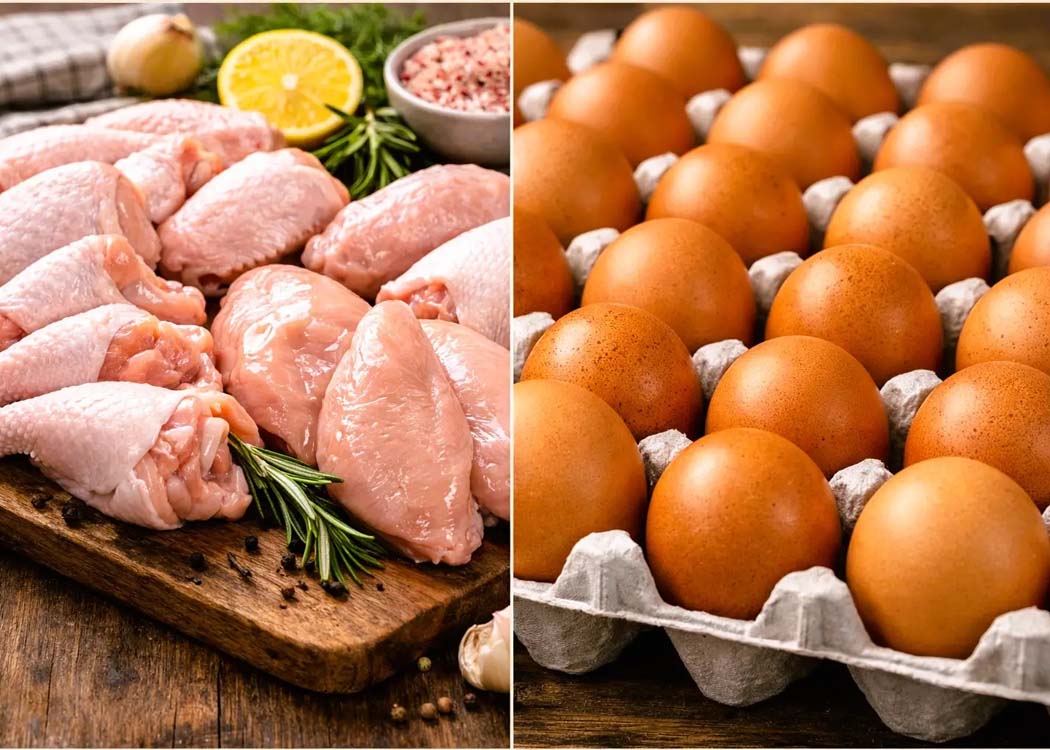
Despite a Rs29 per kg reduction in the government-notified chicken meat rate to Rs541, retailers continue to charge Rs580–650 per kg, while boneless chicken sells for as much as Rs1,100 per kg. The gap between official and market prices extends across vegetables and fruits, adding to household food costs.
LAHORE: Consumers in Lahore are continuing to pay considerably more than government-notified rates for chicken, despite recent reductions in official poultry prices, highlighting the persistent gap between Punjab’s price-control measures and the rates charged in retail markets.
The notified price of chicken meat was reduced by Rs29 per kg to Rs541, while the official rate for live broiler chicken fell by Rs20 to between Rs359 and Rs373 per kg. However, market rates remained substantially higher, with chicken meat selling between Rs580 and Rs650 per kg across the city.
Boneless chicken was even more expensive, retailing at Rs900–1,100 per kg, placing it well beyond the notified price of ordinary chicken meat.
The latest market survey also reported that live birds remained largely unsold across the city despite the reduction in official rates. The figures point to a continuing disconnect between notified prices, poultry supply and the prices consumers encounter at retail outlets.
Chicken prices remain above notified rates
The difference between the official and retail rates is particularly significant for chicken meat. At the upper end of the reported retail range, consumers are paying Rs109 more per kilogram than the notified rate of Rs541.
Even at Rs580 per kg, the retail price exceeds the official rate by Rs39. Boneless chicken, meanwhile, commands a substantially higher price, reaching Rs1,100 per kg.
The continued overcharging raises questions about the effectiveness of market monitoring and enforcement. Although official reductions are intended to provide relief to consumers, the reported retail prices indicate that these cuts have not been fully reflected in market transactions.
The survey does not provide a separate egg-price update or explain the reasons behind the gap between notified and retail poultry prices.
Vegetable prices show similar gaps
The discrepancy is not limited to poultry. Several commonly consumed vegetables were also being sold above their government-notified rates, despite a mixed movement in official prices.
Tomatoes recorded a Rs45 per kg increase in their notified rate to Rs140–175 per kg, while retail prices reached Rs250–280 per kg. Sugar-free potatoes were officially priced at Rs50–54 per kg but sold for Rs80–100 per kg.
Onions, despite a Rs10 reduction in the notified rate to Rs185–195 per kg, continued to retail at Rs220–250 per kg. Local garlic was officially priced at Rs230–240 per kg but sold for Rs300–320, while Chinese garlic reached approximately Rs800 per kg against its notified rate of Rs410–430.
Other vegetables also recorded substantial differences. Spinach, officially priced at Rs38–40 per kg, sold for Rs80–100, while bitter gourd retailed at Rs200–250 against a notified rate of Rs133–140 per kg. Brinjal was sold at Rs140–160 per kg, compared with its official rate of Rs85–90.
Fruit prices add to household expenses
Fruit markets also showed considerable differences between notified and retail rates, with dates among the most expensive items in the survey.
Dates were officially priced at Rs310–435 per kg but sold for Rs800–2,400 per kg. Sundarkhani grapes retailed at Rs800–1,000 per kg against a notified rate of Rs640–670, while Gola grapes sold for Rs400–500 compared with the official rate of Rs270–290.
Kandhari pomegranates were priced at Rs700–800 per kg, despite a notified rate of Rs555–580. Different varieties of apples sold for Rs300–600 per kg against official rates ranging from Rs210 to Rs405.
Bananas, sweet lime and several other fruits were also reported above their notified prices.
Calls for stronger price enforcement
The latest figures highlight the challenge facing authorities in translating official price notifications into actual relief for consumers. Reductions in notified rates have not necessarily resulted in equivalent reductions at retail outlets, while several food items continue to sell substantially above their official prices.
Consumers have called for more effective market monitoring and sustained action against overcharging, arguing that issuing price lists alone does little to contain household expenses when retailers continue to charge higher rates.
For poultry consumers in particular, the gap between the notified chicken meat price and retail rates remains a pressing concern. The latest survey indicates that the impact of official price reductions is yet to reach many buyers across Lahore’s markets.