

A national training workshop at UVAS Lahore brought scientists, researchers and students together to explore how artificial intelligence can support protein design, genetic engineering and the development of biological products.
LAHORE: Artificial intelligence is increasingly finding its way into biotechnology laboratories, offering scientists new ways to analyse complex biological information, explore protein structures and improve research into biological products.
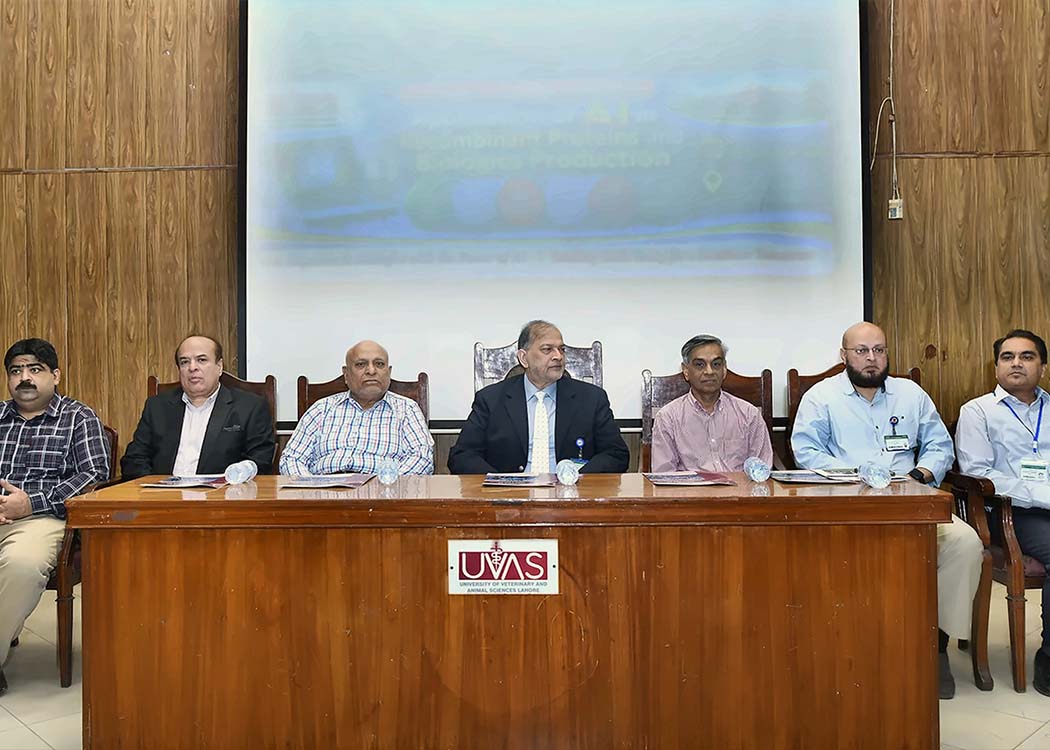
Recognising the growing importance of these technologies, the University of Veterinary and Animal Sciences (UVAS), Lahore, organised a day-long national training workshop on “Applications of Artificial Intelligence (AI) in Recombinant Proteins and Biologics Production” at its City Campus on November 19, 2026.
Organised by the university’s Institute of Biochemistry and Biotechnology (IBBT), the workshop brought academic experts, researchers, professionals and students together to examine how AI-based computational tools can support modern biotechnology research, particularly in recombinant protein development, genetic engineering and biologics production.
The programme reflected a broader shift in scientific research, where computational approaches are increasingly complementing conventional laboratory methods and creating opportunities to investigate complex biological processes more efficiently.
AI becoming essential to modern scientific research
Prof Dr Masood Rabbani, Vice-Chancellor of UVAS Lahore, presided over the inaugural session and emphasised the growing importance of artificial intelligence across scientific disciplines.
Addressing participants, he described AI knowledge and skills as increasingly necessary for students, teachers, researchers and scientists seeking to remain relevant in a rapidly evolving technological environment.
He stressed that academic institutions and scientific professionals must develop the ability to understand and apply modern AI tools rather than remain dependent solely on traditional research approaches.
According to the Vice-Chancellor, adopting emerging technologies is essential for addressing future scientific challenges and keeping pace with advances in science and technology.
His remarks highlighted the importance of preparing researchers not merely to use digital tools, but to integrate emerging technologies into their scientific work in meaningful and responsible ways.
During the inaugural proceedings, Prof Dr Masood Rabbani also presented commemorative shields to guest speakers in recognition of their contributions.
Bringing AI into recombinant protein and biologics research
The workshop’s principal focus was the application of artificial intelligence to recombinant proteins and biologics, an area of biotechnology with important implications for medicine, veterinary science, diagnostics and biological product development.
Recombinant proteins are produced using genetic engineering techniques that enable living cells to manufacture specific proteins. Such technologies are used in the development of biological medicines, diagnostic reagents, enzymes and certain vaccines.
Traditionally, the development of these products involves extensive laboratory experimentation, molecular analysis and repeated optimisation.
AI-based computational approaches offer additional methods for analysing biological data, predicting molecular behaviour and identifying promising research directions before further laboratory testing.
The workshop examined how these capabilities can be incorporated into different stages of recombinant protein and biologics research.
Prof Dr Ali Raza Awan, Principal Organiser of the workshop, outlined the objectives of the programme and highlighted the scientific potential of applying artificial intelligence to the development and production of recombinant proteins.
He identified the subject as an emerging and advanced area of biotechnology, with opportunities for researchers to explore new approaches to biological design and production.
From AI prompting to protein characterisation
The technical programme addressed several interconnected areas of AI-assisted biotechnology.
Among the topics discussed were AI platform prompting techniques and their applications, providing participants with insight into how computational tools can be used to support scientific tasks.
The workshop also covered production strategies and the characterisation of recombinant peptides, alongside the use of bioinformatics software and AI-based tools in genetic engineering.
Another important area was AI-assisted design and computational analysis for recombinant proteins and biologics production.
These approaches can help researchers examine biological sequences, investigate molecular characteristics and evaluate possible design strategies.
In practical terms, such tools may assist scientists in identifying promising candidates for further experimentation, interpreting complex datasets and refining research hypotheses.
However, computational predictions do not replace laboratory validation. Biological products must still undergo appropriate experimental testing, quality assessment and, where applicable, regulatory evaluation.
The workshop’s subject matter therefore brought together two increasingly connected areas of scientific practice: laboratory-based biotechnology and computational analysis.
Relevance for veterinary science, vaccines and biotechnology
Although the workshop focused on recombinant proteins and biologics broadly, the technologies discussed have potential applications across several scientific and industrial sectors.
In veterinary and animal health research, recombinant protein technology contributes to the development of diagnostic tools, vaccine components and other biological products.
For livestock and poultry-related research, these approaches may support future investigations into infectious diseases, pathogen detection and vaccine development.
AI-assisted protein analysis could also help researchers explore molecular targets or assess potential biological candidates before undertaking more resource-intensive laboratory experiments.
These are potential applications of the technologies rather than specific products or research breakthroughs announced during the UVAS workshop.
The wider significance lies in expanding researchers’ familiarity with tools that may increasingly influence how biological products are designed, evaluated and developed.
For Pakistan’s biotechnology sector, building technical expertise in these areas can help strengthen the connection between academic research, laboratory practice and future industrial applications.
Senior academics and researchers attend workshop
The national training workshop was attended by senior faculty members and academic specialists from UVAS and other institutions.
Alongside Prof Dr Masood Rabbani, Vice-Chancellor of UVAS Lahore, the proceedings were attended by Prof Dr Kamran Ashraf, Dean of the Faculty of Veterinary Science, and Prof Dr Waseem Shahzad, Director of the Institute of Biochemistry and Biotechnology (IBBT).
Other academics present included Prof Dr Habib-Ur-Rehman, Prof Dr Asim Aslam and Prof Dr Muhammad Saleem from the University of the Punjab.
Prof Dr Ali Raza Awan served as Principal Organiser, contributing to the academic direction of the programme.
Students, researchers and other participants also attended the day-long training activity, which was intended to improve awareness of emerging technologies and strengthen scientific knowledge and practical research skills.
The participation of senior academics alongside students and researchers reflected the workshop’s emphasis on bringing different levels of scientific expertise into discussions about AI-driven biotechnology.
Preparing the next generation of biotechnology researchers
Artificial intelligence is changing how scientists approach problems involving large datasets, molecular structures and complex biological systems.
For emerging researchers, understanding these tools is becoming increasingly relevant as biotechnology research moves towards greater integration of computational and experimental techniques.
Yet effective use of AI requires more than familiarity with software platforms.
Researchers must also understand the scientific principles behind the problems they are investigating, recognise the limitations of computational predictions and interpret results critically.
Training initiatives such as the UVAS workshop can help build these competencies by exposing participants to new technologies and demonstrating their relevance to established scientific disciplines.
The programme also highlighted the value of continuing professional development in fields where technological advances can rapidly influence research methods.
By focusing on both AI tools and the fundamentals of biologics production, the workshop addressed an important aspect of modern biotechnology education: preparing scientists to work confidently across traditional laboratory and emerging computational environments.
The day-long national training workshop concluded as part of UVAS Lahore’s efforts to promote awareness of advanced scientific methods and equip students, researchers and professionals with knowledge of AI-assisted biotechnology.
As artificial intelligence becomes increasingly integrated into biological research, developing expertise in its responsible and effective use may prove important for the future of scientific innovation.
The emerging challenge for biotechnology researchers is not simply to adopt artificial intelligence, but to understand how its capabilities can be translated into reliable scientific research and meaningful biological applications.