

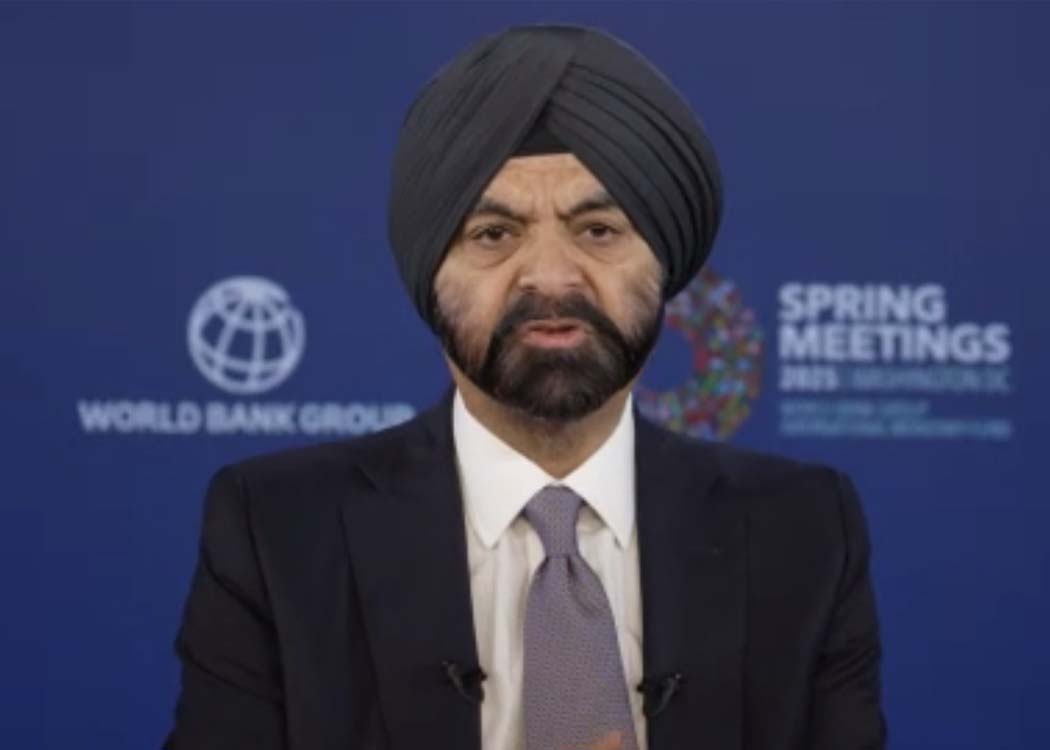
World Bank President Ajay Banga warns that failure to create millions of jobs annually could trigger instability and migration, urging power sector reform and private investment-led growth
KARACHI: Pakistan will need to create between 25 and 30 million new jobs over the next decade to absorb its rapidly growing young population and prevent economic and social strain, World Bank President Ajay Banga said during a visit to Karachi. He stressed that agriculture, along with infrastructure and services, must play a central role in meeting this employment challenge.
Speaking about Pakistan’s long-term development outlook, Banga described job creation as the country’s most urgent economic priority. With millions of young people entering the workforce every year, Pakistan must generate roughly 2.5 to 3 million jobs annually to convert its demographic growth into an economic advantage rather than a source of instability. He cautioned that failure to do so could increase outward migration and deepen domestic pressures.
Banga said Pakistan is now moving into the implementation phase of a 10-year Country Partnership Framework with the World Bank, while also working with the International Monetary Fund to stabilise its economy. Under this framework, the World Bank Group is expected to mobilise around $4 billion per year through a mix of public and private financing, with a large share coming from private-sector operations led by the International Finance Corporation.
According to Banga, Pakistan’s employment strategy must rest on three core pillars: strengthening human and physical infrastructure, introducing business-friendly regulatory reforms, and expanding access to finance and insurance for small businesses and farmers. He noted that nearly 90% of jobs in Pakistan are created by the private sector, making private investment critical for sustainable growth.
Agriculture was highlighted as one of the most powerful engines for employment. Banga said farming and related activities could account for nearly one-third of the jobs Pakistan needs to create by 2050, particularly if productivity improves and value chains are expanded. Alongside agriculture, sectors such as infrastructure development, primary healthcare, tourism, and small enterprises were identified as labour-intensive areas with strong job potential.
He also pointed to Pakistan’s growing freelance and digital workforce as a sign of entrepreneurial energy, but warned that these workers need better access to capital, infrastructure, and institutional support to scale up into businesses that can employ others. The pressure to create jobs is already visible in the rising number of skilled professionals leaving the country, including thousands of doctors who emigrated last year in search of better opportunities and working conditions.
In the short term, Banga said reforming Pakistan’s power sector is the most urgent priority for economic recovery and job growth. Despite improvements in electricity generation, inefficiencies in distribution, weak bill collection, and rising debt have discouraged investment and constrained business activity. He stressed that greater private-sector participation and progress on privatisation are essential to restoring financial stability in the sector.
He warned that while rooftop solar adoption is helping households and firms manage energy costs, it could destabilise the grid if distribution reforms are not accelerated. Reliable and affordable electricity, he said, is fundamental to employment across all sectors, including health, education, manufacturing, and agriculture.
Banga also emphasised that climate resilience must be built directly into Pakistan’s development planning. Rather than treating climate as a separate issue, he urged integrating resilience into infrastructure, housing, water management, and agriculture. This approach, he said, would protect livelihoods while supporting long-term job creation in a country highly exposed to floods, heatwaves, and erratic weather patterns.
Describing Pakistan’s future in the World Bank’s global strategy, Banga said he viewed the country not as a crisis case but as a long-term opportunity for employment-driven growth. He concluded that turning Pakistan’s youth population into a productive workforce is a generational task, and success will depend on sustained reforms, private investment, and sectoral strategies that place jobs at the centre of economic policy.