

Government plans high-tech facility at NARC to develop local machinery, boost precision farming, and train over 500 stakeholders
ISLAMABAD: Pakistan is preparing to take a major leap into the future of agriculture with a proposed Rs990 million smart farming initiative aimed at modernising the sector through advanced technologies and locally developed machinery.
The Ministry of National Food Security and Research has put forward a comprehensive five-year project to establish a Digital and Precision Agriculture Mechanisation Facility at the National Agricultural Research Centre (NARC) in Islamabad. The project will be executed by the Agricultural Engineering Institute (AEI), positioning NARC as a central hub for next-generation farming solutions.
Planned from July 2026 to June 2031, the initiative focuses on accelerating the adoption of precision agriculture while strengthening Pakistan’s capacity to design and manufacture its own agricultural equipment.
At its core, the project seeks to shift farming practices toward data-driven, resource-efficient methods, enabling farmers to increase productivity while reducing input costs. It also aims to address long-standing gaps in mechanisation, particularly for small and medium-scale farmers who often lack access to modern tools.
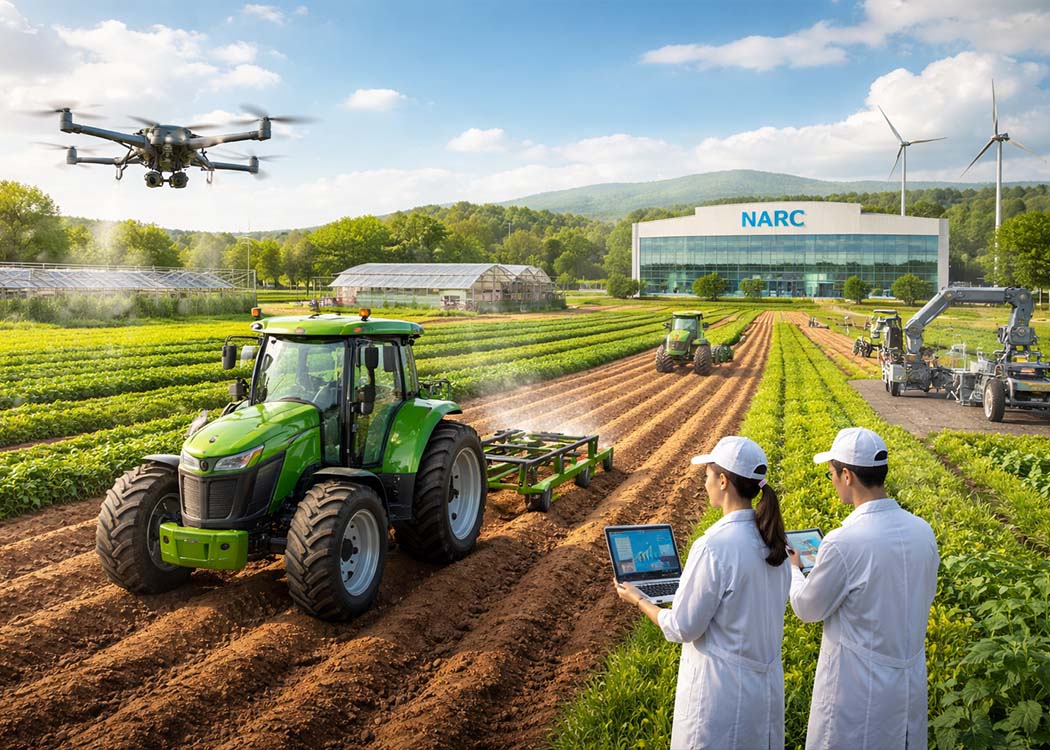
To achieve this, the facility will upgrade three critical components: a design laboratory, a prototype development workshop, and a testing lab equipped with advanced technologies such as 3D scanning, computer-aided design (CAD), simulation tools, CNC machinery, and laser cutting systems.
The project goes beyond traditional mechanisation by integrating cutting-edge technologies into agriculture. Plans include the development and application of artificial intelligence (AI), Internet of Things (IoT), unmanned aerial vehicles (UAVs), and robotics, alongside the establishment of a dedicated UAV and agricultural robotics unit.
Officials say at least five locally designed agricultural machine prototypes will be developed and tested under the initiative, marking a significant step toward reducing reliance on imported machinery. At the same time, training and capacity-building programs will be conducted to equip more than 500 stakeholders—including farmers, engineers, researchers, and manufacturers—with the skills needed to operate and scale these technologies.
The proposal is aligned with Pakistan’s broader development priorities, including the 5Es Framework, the 13th Five-Year Plan, the UN Sustainable Development Goals (SDGs), and the National Agriculture Innovation and Growth Programme (NAIGP). It also emphasizes support for agri-based small and medium enterprises (SMEs), encouraging local innovation and industrial growth.
Beyond technology, the initiative reflects a strategic shift toward self-reliance and sustainability in agriculture. By promoting indigenous machinery development and fostering collaboration between research institutions and industry, the project aims to build a more resilient and competitive agricultural ecosystem. If approved and implemented effectively, the initiative could redefine how farming is practiced in Pakistan—transforming it from traditional methods to a precision-driven, technology-enabled system capable of meeting future food security challenges.