

Khalid Munir, PhD (Canada), DVM (Canada)
Muhammad Arshad, DVM, PhD
Asghar Chaudhry, BVSc, BSc, MSc (Hons.)
Muhammad Akram Munir, BVSc, BSc, MS (USA), PhD (USA)
Asif Idrees, DVM, PhD, Postdoc (USA)
Hammad Ahmed Hashmi, DVM, MSc (Hons), EMBA, CMILT (UK)
Introduction
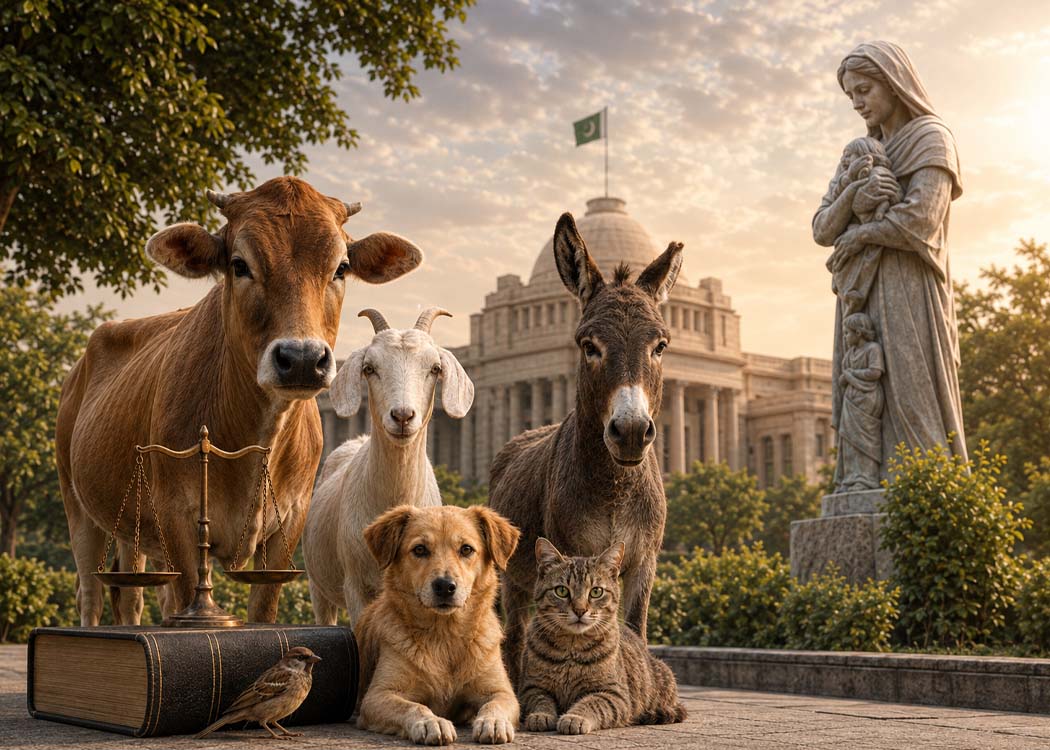
In an era dominated by debates over climate change, environmental degradation, pollution, and biodiversity loss, another profound moral crisis remains largely hidden in plain sight: the treatment of the non-human inhabitants of our planet. Animal welfare is not merely a modern secular cause. Throughout human history, religious traditions, moral philosophy, and legal systems have recognized that human power over animals carries corresponding responsibilities. Judaism, Christianity, and Islam all contain teachings emphasizing mercy, stewardship, responsible use, and the prevention of unnecessary suffering.
Modern states have increasingly translated these principles into legislation, regulatory institutions, and enforcement mechanisms. The United States, European Union, and Australia provide different examples of how animal protection can be incorporated into modern governance. Pakistan, however, continues to struggle with an outdated and fragmented legal framework despite possessing a rich Islamic tradition of compassion toward animals and several recent signs of legal progress. The challenge is therefore not simply to recognize that animals deserve humane treatment. It is to translate ethical and religious principles into enforceable standards, competent institutions, veterinary oversight, effective penalties, and a culture of responsible stewardship.
The Abrahamic mandate: Animals as sacred trusts
For billions of people, religious teachings remain a fundamental source of moral guidance. A closer examination of Judaism, Christianity, and Islam reveals a shared principle: human dominion over animals is accompanied by responsibility rather than unlimited license.
Judaism and the principle of mercy: Jewish tradition recognizes an obligation to prevent unnecessary suffering to animals, commonly associated with the principle of Tza’ar Ba’alei Chayim. Biblical law contains several specific protections. The Sabbath commandment extends the requirement of rest to livestock; Exodus 20:10 includes cattle and other animals among those who must cease from labor. Deuteronomy 25:4 prohibits muzzling an ox while it is threshing, ensuring that an animal is not prevented from eating while performing its work. Proverbs 12:10 establishes a broader moral principle: “A righteous person knows the needs of his animal.” Together, these teachings portray compassion toward animals as part of righteous human conduct rather than as an optional expression of kindness. It embraces the Hebrew concept of tsa’ar ba’alei hayim—the mandate to prevent the ‘sorrow of living creatures.’ The scriptures teach that God made covenants with animals as well as humans (Gen. 9:9-10; Hosea 2:20). The Hebrew term ‘nefesh chaya’ (‘a living soul’) was applied to animals as well as people (Gen. 1:21, 24).
Christianity and the ethics of stewardship: Christian theology likewise presents humanity as steward of God’s creation rather than its absolute owner. The natural world ultimately belongs to God, and human authority over it carries a duty of care. In Luke 12:6, Jesus refers to sparrows and emphasizes that not one of them is forgotten by God. The passage reflects the broader Christian understanding that non-human creation possesses value in the eyes of the Creator. The image of the Good Shepherd in John 10:11 provides another powerful model of responsible stewardship. The shepherd does not merely possess the flock; he protects, nurtures, and risks himself for it. Applied to animal welfare, this ethical value challenges forms of exploitation that treat living creatures solely as commodities. Christianity has been interpreted as commanding respect for all of nature and its inhabitants. Evidence of caring attitudes towards animals can be found in the Bible, for example: ‘He that killeth an ox is as if he slew a man’ (Isaiah 66.3). ‘For meat destroy not the work of God’ (Romans 14.19-21). ‘A righteous man regardeth the life of the beast’ (Proverbs 12.10).
Islam and the rights of animal communities: Islam provides an especially extensive ethical and legal framework concerning the treatment of animals. The Qur’an states: “There is no creature on earth nor bird that flies with its wings except that they are communities like you” (Qur’an 6:38). This verse recognizes animals as communities within God’s creation and rejects the notion that they are morally insignificant. The Qur’an, the Hadith, and the history of Islamic civilisation offer many examples of kindness, mercy, and compassion for animals. Islam teaches that animals should be given equal consideration to humans. The Holy Prophet Mohammed (PBUH) said, “It behoves you to treat the animals gently” (Hadith Muslim, 4:2593). “And the earth—He has assigned it to all living creatures” (Qur’an Majeed, 55:10–12). “All creatures are like a family to God” (Hadith Mishkat, 3:1392), and “A good deed done to an animal is as meritorious as a good deed done to a human being, while an act of cruelty to an animal is as bad as an act of cruelty to a human being” (Hadith Mishkat, Book 6, Ch. 7, 8:178).
The Prophet Muhammad (peace be upon him) encountered widespread animal exploitation in seventh-century Arabia and established principles intended to prevent unnecessary cruelty. He condemned animal fighting, prohibited the use of living creatures as targets, forbade striking animals on the face, and condemned unnecessary mutilation. The Prophetic tradition also demonstrates concern for animals’ physical and emotional well-being. In one account, the Prophet rebuked a companion who had taken young birds from a nest and ordered that they be returned to their mother. Other teachings addressed the treatment of dependent animals and prohibited practices that deprived offspring of necessary nourishment. Humane treatment was also emphasized in relation to slaughter. Prophetic teachings instructed Muslims to sharpen the knife and minimize the animal’s suffering while avoiding practices that unnecessarily frighten or distress the animal. These principles establish that the legitimate use of animals for food does not remove the obligation to treat them humanely. The Prophet also regulated the burdens imposed upon working animals. He warned people against using the backs of animals merely as seats during travel. In a well-known account recorded by Abu Dawood, he encountered an emaciated camel whose condition reflected hunger and overwork. The Prophet comforted the animal and confronted its owner, warning him to fear God regarding an animal placed in his care. Similarly, when companions burned an ant colony, the Prophet ordered the fire extinguished and reprimanded them, emphasizing that punishment by fire belongs to the Creator. Such teachings extend compassion beyond economically valuable animals to even the smallest creatures. The Prophet Muhammad (peace be upon him) warned that, on the Day of Judgement, rights will be restored between all creatures, meaning cruelty carries eternal consequences. Islamic jurisprudence further developed restrictions on hunting for sport, animal fighting, baiting, live-target practices, unnecessary mutilation, and overloading of working animals. The Prophetic traditions also contain powerful examples of spiritual accountability: a woman was condemned for confining a cat until it died of starvation, while a person was granted divine mercy for providing water to a thirsty dog. These teachings establish the principle that cruelty toward animals is not merely a social wrong but can constitute a religious and moral transgression.
Hinduism: The animal welfare in context: Bhagavad Gita (verse 5.18) proclaims that a self-realised soul is able to understand the equality of all beings.
Buddhism: Buddhism is based upon a universal idea of compassion for all life. A man is holy if he has pity on all living creatures.
Bahá’í: The Bahá’í Faith draws upon many of the world’s religions, advocating compassion towards all creation. `Abdu’l-Bahá, son of the Bahá’u’lláh, wrote: “Then, O ye friends of God! Ye must not only have kind and merciful feelings for mankind, but ye should also exercise the utmost kindness towards every living creature.”
Native American: Native American traditions and beliefs vary quite widely, but a common theme is a sense that all of Nature is sacred. All animate and inanimate objects are related to the Divine and command respect. Humans, as part of Nature, participate in the cycle of life and death, but no animal is killed gratuitously or without respect for its soul.
Accountability and the protection of animal communities: Islamic teachings also introduce the concept of accountability beyond this life. The principle of qisas—restoration of rights and justice—has been discussed in Islamic tradition in relation to animals and other creatures. The broader message is that human beings are accountable for how they exercise authority over creation. This responsibility extends beyond individual animals to their habitats. The Islamic concept of hima, or protected areas, provided a mechanism for conserving land and resources and restricting harmful exploitation. The Prophet Muhammad (peace be upon him) established protected areas around Madinah, demonstrating that stewardship could extend from individual acts of kindness to the preservation of entire animal communities and their environments. Thus, Islamic teachings present animal welfare as a multidimensional obligation involving compassion, prevention of suffering, responsible use, habitat protection, and ultimate accountability.
From faith to state: Modern enforcement frameworks
Moral teachings can establish principles, but lasting protection requires laws, institutions, and enforcement. Several modern jurisdictions provide useful examples.
The United States: The United States operates a multilayered animal-welfare system involving federal statutes, state criminal laws, administrative regulations, and local enforcement. The Animal Welfare Act (AWA) establishes minimum standards for the care and treatment of certain animals used in research, teaching, testing, exhibition, commercial activities, and transportation. Its scope is defined by statute and does not cover every animal or every form of animal use. The Humane Methods of Slaughter Act establishes humane slaughter requirements for covered livestock and requires appropriate handling and slaughter methods designed to reduce suffering. The Preventing Animal Cruelty and Torture (PACT) Act, enacted in 2019, made certain extreme acts of animal cruelty federal offenses, including specified forms of crushing, burning, drowning, suffocation, impalement, and other serious abuse. These federal laws operate alongside state animal-cruelty statutes, which often provide broader protections and penalties. Local police, animal-control agencies, humane officers, veterinarians, and specialized organizations may all contribute to enforcement. The American model demonstrates that animal welfare is most effective when legislation is supported by professional enforcement, veterinary expertise, administrative oversight, and meaningful penalties.
Europe: Animals as sentient beings: The European Union has taken an important conceptual step by recognizing animal sentience in its foundational law. Article 13 of the Treaty on the Functioning of the European Union requires the Union and its Member States to pay full regard to animal-welfare requirements when formulating and implementing specified policies. Several European countries have gone further by incorporating animal protection into their constitutions. Germany, Switzerland, and Austria are prominent examples of countries in which constitutional or foundational legal provisions recognize the state’s responsibility toward animals. European regulation has also influenced agriculture, scientific research, transport, slaughter, and other forms of animal use. Restrictions on certain forms of intensive confinement, fur production, and cosmetic testing illustrate the broader movement toward treating animal welfare as an established component of public policy. The European experience demonstrates the importance of recognizing animal sentience and integrating welfare considerations into legislation rather than treating cruelty solely as an issue of individual misconduct.
Australia’s regulatory landscape: Australia provides another useful model, although its system differs from both the United States and Europe. Animal welfare is primarily regulated by state and territory legislation, supported by nationally developed standards and guidelines. These laws establish duties of care and prohibit cruelty and neglect across a range of circumstances, including livestock production, transportation, and the keeping of animals. In several jurisdictions, organizations such as the RSPCA have statutory powers to investigate animal cruelty, intervene in welfare cases, seize animals under defined circumstances, and initiate legal proceedings. Australia therefore demonstrates the value of cooperation among government authorities, veterinary professionals, welfare organizations, and animal owners, supported by clear legal responsibilities and enforceable standards.
Pakistan: A crisis of conscience
Pakistan presents a particularly important contradiction. A country whose religious tradition contains extensive teachings on mercy toward animals continues to experience widespread animal-welfare challenges. The cornerstone of Pakistan’s animal-cruelty legislation remains the Prevention of Cruelty to Animals Act, 1890. Although the Act establishes basic prohibitions against cruelty, it was enacted more than a century ago, and its penalty structure and regulatory approach are poorly suited to contemporary animal-welfare challenges. The problem is not simply the absence of laws. It is also the weakness of enforcement, institutional fragmentation, limited public awareness, economic pressures, and insufficient veterinary oversight.
Eid-ul-Adha and the welfare of sacrificial animals: The treatment of animals during Eid-ul-Adha deserves particular attention because of the enormous number of animals transported, housed, and slaughtered during this period. In the weeks surrounding Eid, cattle, goats, sheep, and camels may be transported long distances under stressful conditions. Some are overcrowded in vehicles, tied in uncomfortable positions, and exposed to inadequate food, water, ventilation, rest, and veterinary care. At livestock markets and temporary urban holding areas, animals may face insufficient shade, limited space, poor sanitation, injuries, rough handling, and prolonged exposure to heat and human activity. In some circumstances, animals may also be exposed to the slaughter of other animals, potentially increasing fear and distress. These concerns do not challenge the religious practice of sacrifice itself. Rather, they concern how animals are treated before and during the sacrifice. Islamic principles provide a strong basis for ensuring that transport, handling, housing, restraint, and slaughter are conducted with compassion and minimum suffering. Improved veterinary inspection, appropriate transport standards, adequate water and rest, shade, trained handlers, humane restraint, and properly designed slaughter facilities could significantly improve welfare while fully respecting the religious purpose of Eid-ul-Adha.
Working animals: The welfare crisis extends far beyond sacrificial animals. Donkeys, mules, horses, oxen, and other working animals remain important to agriculture, transportation, construction, and informal economies. Many are exposed to excessive workloads, inadequate nutrition, poor harnessing, harsh environmental conditions, injuries, and insufficient veterinary care. Animals working at brick kilns and in urban markets are particularly vulnerable. Overloading, beating, inadequate rest, and failure to treat wounds or disease can result in chronic suffering and premature death. A modern welfare framework should therefore establish enforceable standards for load limits, working hours, rest periods, nutrition, water, shelter, harnessing, veterinary care, and humane retirement when animals are no longer fit for work.
Wildlife and captive animals: Unregulated roadside zoos, wildlife markets, and inappropriate private ownership of wild or exotic animals create additional welfare concerns. Captive animals may be kept in cramped or unsuitable environments without adequate nutrition, environmental enrichment, veterinary care, or species-appropriate conditions. Wildlife protection should therefore address not only illegal hunting and trade but also the welfare of animals kept in captivity. Strong licensing, inspection, species-specific standards, and meaningful penalties are necessary to prevent commercial exploitation from overriding animal welfare.
Stray-animal management: The management of stray animals presents another serious challenge. Indiscriminate poisoning and shooting, including the use of toxic substances, are inhumane and do not provide a sustainable solution to population growth. Local governments should transition toward integrated population-management strategies incorporating vaccination, sterilization where appropriate, adoption and rehoming, responsible ownership, improved waste management, and public education.
For free-roaming dogs, rabies vaccination is particularly important because animal welfare and public health are closely connected. Sustainable management should therefore protect both human communities and animals.
Recent signs of legal progress in Pakistan
Despite these shortcomings, Pakistan’s legal landscape is evolving. The Islamabad High Court’s Kaavan judgment, in Islamabad Wildlife Management Board v. Metropolitan Corporation Islamabad, represented an important development in Pakistani animal-welfare jurisprudence. The Court emphasized that living beings possess value and that the state has responsibilities toward animals in captivity. The Khyber Pakhtunkhwa Animal Welfare Act, 2024 represents a significant legislative development. It adopts a more contemporary approach to animal welfare, addressing unnecessary pain, injury, fear, distress, neglect, transportation, and humane treatment. Punjab has also taken steps to strengthen wildlife protection through amendments to its wildlife legislation, including stronger enforcement mechanisms and greater regulation of wildlife ownership. These developments demonstrate that Pakistan can move beyond the limitations of the 1890 framework.
The way forward: A roadmap for reform
1. Enact a modern animal-welfare framework
Pakistan should replace or comprehensively reform the Prevention of Cruelty to Animals Act, 1890, through modern legislation that clearly defines cruelty, neglect, abandonment, and unacceptable treatment. At the federal level, the proposed Animal Welfare Act seeks to replace the country’s antiquated animal cruelty framework with modern legislation that establishes a statutory duty of care towards animals, strengthens penalties for cruelty and neglect, and improves enforcement and welfare standards. While legislation alone cannot eliminate animal suffering, these reforms present a significant opportunity to build a more humane legal framework—provided they are enacted without delay and implemented consistently and effectively. Once the federal Act is consolidated, the next challenge is to harmonize federal and provincial legislation and ensure that improved laws are supported by effective institutions and enforcement. A contemporary framework should establish enforceable standards for companion animals, working animals, livestock, transportation, markets and holding facilities, slaughter, captive wildlife, veterinary care, and animal research and commercial activities where applicable. The law should recognize that welfare involves more than preventing physical injury. Animals can experience pain, fear, distress, hunger, thirst, exhaustion, and other adverse states that should be addressed through enforceable standards. Penalties must also provide genuine deterrence and could include substantial fines, imprisonment for serious offences, confiscation of animals, compensation for veterinary and rehabilitation costs, and disqualification from animal ownership in appropriate cases.
2. Establish specialized animal-welfare enforcement units
Laws are meaningful only when they are enforced. Provincial and local governments should establish dedicated animal-welfare enforcement units staffed by trained personnel and supported by veterinary professionals. Their responsibilities should include investigating cruelty complaints, inspecting facilities, responding to emergencies, rescuing abused animals, addressing illegal animal fighting, monitoring animal markets, and coordinating with police, livestock, wildlife, and municipal authorities. A standardized training and certification system would improve investigation, evidence collection, veterinary assessment, animal seizure, and prosecution.
3. Strengthen veterinary involvement
Veterinarians should occupy a central role in animal-welfare policy and enforcement. Veterinary professionals are uniquely qualified to assess pain, injury, malnutrition, disease, fitness for transport, working capacity, neglect, and humane slaughter. Their involvement would also help ensure that regulations are based on contemporary scientific evidence rather than assumptions or tradition alone. Animal welfare should therefore be recognized as a multidisciplinary field involving veterinary medicine, law, public health, agriculture, wildlife management, environmental science, and ethics.
4. Institutionalize humane stray-animal management
Indiscriminate shooting and poisoning should be replaced with evidence-based population management. A national strategy should integrate rabies vaccination, sterilization programs where appropriate, responsible ownership, adoption and rehoming, improved waste management, public education, and systematic population monitoring. Such an approach would protect animal welfare while simultaneously addressing public-health concerns.
5. Establish humane Eid-ul-Adha standards
Given the scale of animal movement during Eid-ul-Adha, specific welfare protocols should be established for the transport, housing, watering, handling, restraint, veterinary inspection, and slaughter of sacrificial animals. Religious scholars, veterinarians, livestock authorities, municipal administrations, and community organizations should collaborate to develop practical standards consistent with both Islamic teachings and modern animal-welfare science. The religious significance of sacrifice should be accompanied by the ethical responsibility to minimize the suffering of the animal being sacrificed.
6. Promote public awareness and religious leadership
Legislation alone cannot transform social attitudes. Animal welfare should become part of veterinary and agricultural education, professional training, school programs, and public-awareness campaigns. Religious scholars and institutions can play a particularly important role by reminding communities that compassion toward animals is deeply embedded in Islamic teachings. This approach would help demonstrate that animal welfare is not an imported or exclusively Western concept. Modern welfare science can instead complement longstanding religious and cultural principles of mercy, stewardship, and responsible treatment.
Conclusion
Animal welfare is ultimately a measure of human responsibility. Judaism, Christianity, and Islam all provide enduring ethical foundations for compassion toward animals. Modern legal systems demonstrate how such principles can be translated into enforceable standards, regulatory institutions, veterinary oversight, and meaningful penalties.
Pakistan possesses both a strong religious foundation and emerging legal precedents for developing a modern animal-welfare system. The Kaavan judgment, the Khyber Pakhtunkhwa Animal Welfare Act, 2024, and evolving provincial wildlife legislation demonstrate that change is possible. What remains necessary is to move from isolated reforms to a coherent national framework supported by effective enforcement. The treatment of animals during Eid-ul-Adha, the exploitation of working animals, the management of stray populations, the regulation of captive wildlife, and the enforcement of cruelty laws should no longer be treated as disconnected issues. They are manifestations of the same underlying question: how human beings exercise power over vulnerable living creatures. True progress cannot be measured solely by economic growth, technological advancement, or infrastructure. It must also be measured by how a society treats those who cannot speak for themselves.
By aligning modern animal-welfare legislation with veterinary science and Pakistan’s enduring principles of mercy, compassion, justice, and stewardship, the country can significantly reduce unnecessary suffering while strengthening the rule of law and public trust. Enacting and faithfully enforcing robust animal-welfare laws would not only reduce unnecessary suffering but also strengthen Pakistan’s international standing, enhance its soft power, and demonstrate its commitment to a more humane, just, and progressive society. Protecting animals is not a peripheral concern. It is an expression of the kind of society we choose to become.
In summary, animal rights and welfare have already been highlighted in ancient scriptures and religions, as well as by animal welfare activists. However, the authors contend that there is no up-to-date implementation by the relevant parties and extremely poor public awareness. The legislation may be reviewed, and loopholes in its effectiveness may be addressed.
About the authors:
Dr Khalid Munir is an internationally recognised veterinary leader focused on clinical excellence, research, and animal-welfare advocacy in the United States and worldwide.
Dr Muhammad Arshad is Chairman of the Board of Governors of Multan University of Science and Technology and a leader in veterinary education and academia.
Dr Asghar Chaudhary is a retired USDA Veterinary Medical Officer with extensive expertise in veterinary regulation and animal-welfare laws.
Dr Muhammad Akram Munir is an internationally recognised microbiologist and former Dean and Professor with extensive academic and research leadership experience.
Dr Asif Idrees is an animal pathologist at the University of Veterinary and Animal Sciences, Narowal Campus, dedicated to animal health and welfare.
Dr Hammad Ahmad Hashmi is a veterinarian, a retired military Lieutenant Colonel, a veterinary marketer of companion animal products, and an advocate for animal rights and welfare.
Email for correspondence: k.munir@animalsfirstvethospital.com