

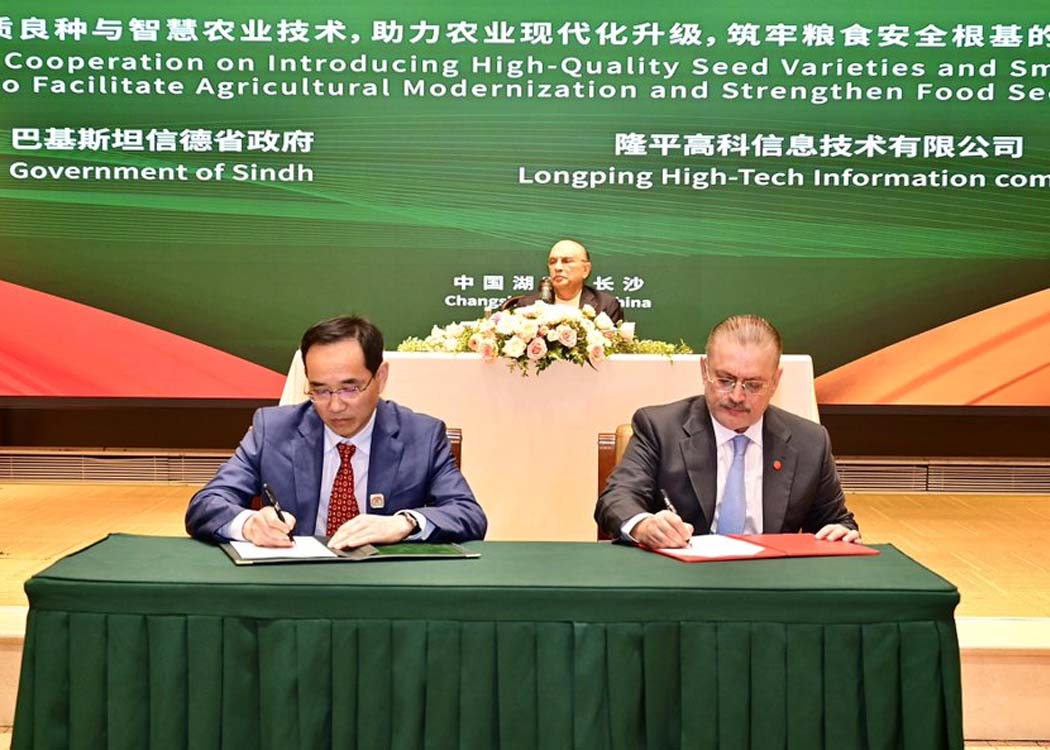
New agreement signals major push in seed innovation, smart farming, and food security as Pakistan partners with leading Chinese agri-tech firm during President Zardari’s China visit
CHANGSHA: Pakistan has taken a significant step toward transforming its agriculture sector by signing a key memorandum of understanding (MoU) with Long Ping High-Tech Agriculture Co., Ltd., marking a strategic shift toward advanced farming, seed innovation, and food security.
The agreement, signed during President Asif Ali Zardari’s ongoing visit to China, reflects a growing focus on modernizing Pakistan’s agriculture through international collaboration and technology transfer.
Signed between the Sindh local government and Long Ping Hi-tech, the MoU aims to introduce cutting-edge agricultural technologies, improve crop yields, and strengthen Pakistan’s capacity to meet rising food demands in the face of climate and population pressures.
Why Long Ping Hi-tech matters
Long Ping Hi-tech is one of China’s leading agricultural technology companies, widely recognized for its expertise in hybrid seed development—particularly hybrid rice. Named after renowned Chinese agronomist Yuan Longping, often called the “father of hybrid rice,” the company has played a pivotal role in boosting agricultural productivity across Asia and beyond.
With strong research and development capabilities, Long Ping Hi-tech focuses on:
- High-yield and climate-resilient seed varieties
- Smart agriculture and precision farming technologies
- Sustainable crop management solutions
Its collaboration with Pakistan is expected to bring these innovations into local farming systems, potentially transforming productivity levels for key crops.
A broader push for agricultural transformation
The MoU was signed by Sindh Senior Minister Sharjeel Inam Memon and Long Ping Hi-tech Chairman Chen Zhixin, underscoring high-level commitment on both sides.
The agreement aligns with Pakistan’s urgent need to modernize its agriculture sector, which remains vulnerable to:
- Climate change and water scarcity
- Low per-acre yield compared to global standards
- Limited access to advanced seed technologies
By partnering with a global agri-tech leader, Pakistan aims to bridge these gaps and move toward more resilient, technology-driven farming practices.
Part of a wider cooperation framework
The agricultural MoU was one of three agreements signed between Pakistan and China, alongside collaborations in desalination and the tea sector.
While a separate desalination project in Karachi aims to address urban water shortages, and a tea sector agreement seeks to boost trade and industry cooperation, the Long Ping Hi-tech partnership stands out for its potential long-term impact on food security and rural livelihoods.
Strengthening economic and scientific ties
President Zardari’s visit to China, spanning Hunan and Hainan provinces, highlights Pakistan’s broader strategy to deepen economic and technological cooperation with Beijing.
In meetings with Chinese leadership, Pakistan also expressed interest in expanding collaboration in:
- Seed technology and agricultural research
- Mechanized and precision farming
- Innovation-driven rural development
The visit included engagements with major Chinese companies and institutions, reinforcing the role of public-private partnerships in driving economic growth.
Looking ahead
As Pakistan faces mounting challenges in food security, population growth, and environmental stress, the partnership with Long Ping Hi-tech could mark a turning point.
If effectively implemented, this collaboration may not only improve crop yields but also redefine how agriculture is practiced—shifting from traditional methods to data-driven, innovation-led farming. In a region where agriculture remains the backbone of the economy, this agreement signals more than cooperation—it signals transformation.