


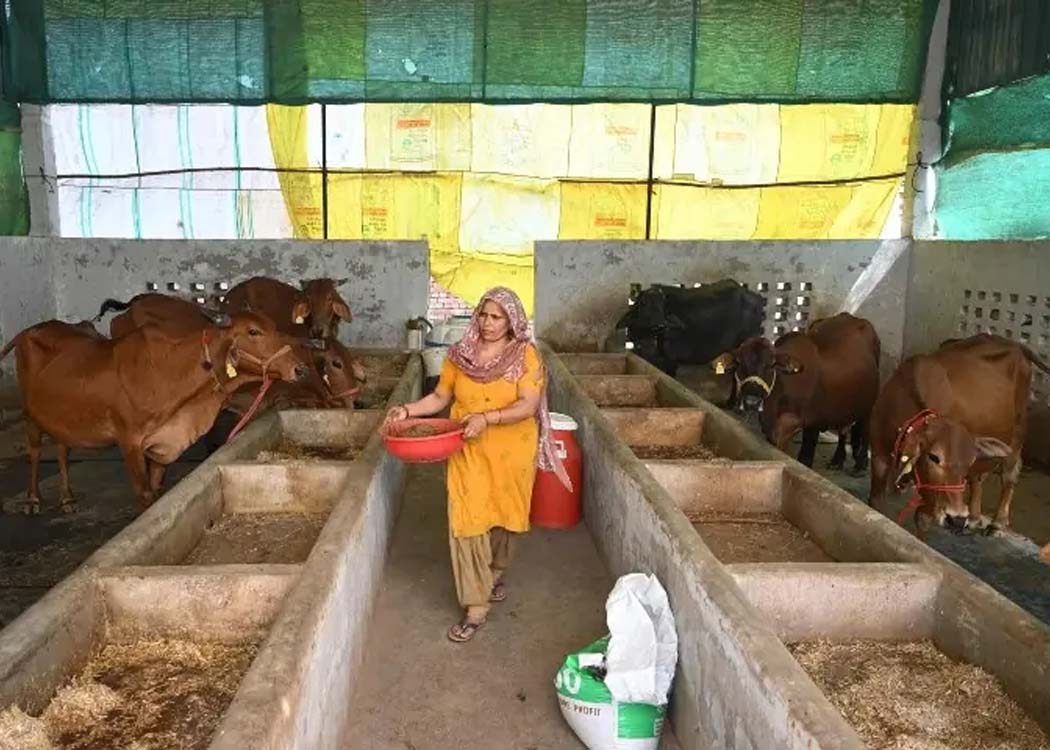
Amid LPG shortages and long queues, rural India increasingly relies on cow-dung biogas systems as a low-cost, sustainable alternative energy source
NEW DELHI: As energy pressures deepen across parts of South Asia following disruptions linked to regional conflict and supply chain instability, rural India is witnessing a quiet but significant shift toward an age-old solution — biogas generated from cow dung.
In several villages across Uttar Pradesh and other agricultural regions, households are turning to locally produced biogas to cope with delays and shortages in liquefied petroleum gas (LPG) cylinders. While officials maintain that there is no national shortage, ground realities tell a different story, with long queues, panic buying, and uneven distribution affecting daily life.
In Nekpur village, Gauri Devi represents this growing transition. Her household stove runs on a steady blue flame powered entirely by biogas produced from cow dung. The system, she explains, is simple yet effective — a mixture of dung and water is fed into an underground digester that produces methane gas for cooking.
India, which consumes more than 30 million tonnes of LPG annually and imports over half its requirement, has been promoting biogas technology since the 1980s. More than five million small-scale digesters have already been installed across rural areas, converting farm waste into fuel and nutrient-rich slurry used as fertilizer.
Farmers say the benefits extend beyond cooking gas. The leftover slurry, often referred to locally as “black gold,” significantly improves soil fertility due to its high nitrogen content compared to raw dung.
However, despite its promise, biogas still remains a secondary energy source for most households. Experts point out that LPG remains more convenient due to established supply chains, while biogas systems require regular maintenance, space, and initial setup costs, even if subsidized.
The Indian Biogas Association notes that these systems function more like “mini factories” and need structured installation and upkeep to scale effectively. Without community-level management or cooperative models, adoption is likely to remain limited.
Still, rising interest in rural areas suggests momentum is building, especially as energy security concerns grow and government policy pushes for increased biogas integration into both household and transportation fuel systems.
For many rural families, however, practical challenges remain. Land constraints, labor demands, and daily survival needs often make adoption difficult, even as LPG shortages push people to stand in long queues under difficult conditions. As India balances energy demand, rural livelihoods, and climate commitments, biogas is increasingly emerging not just as an alternative — but as a potential pillar of its long-term energy strategy.